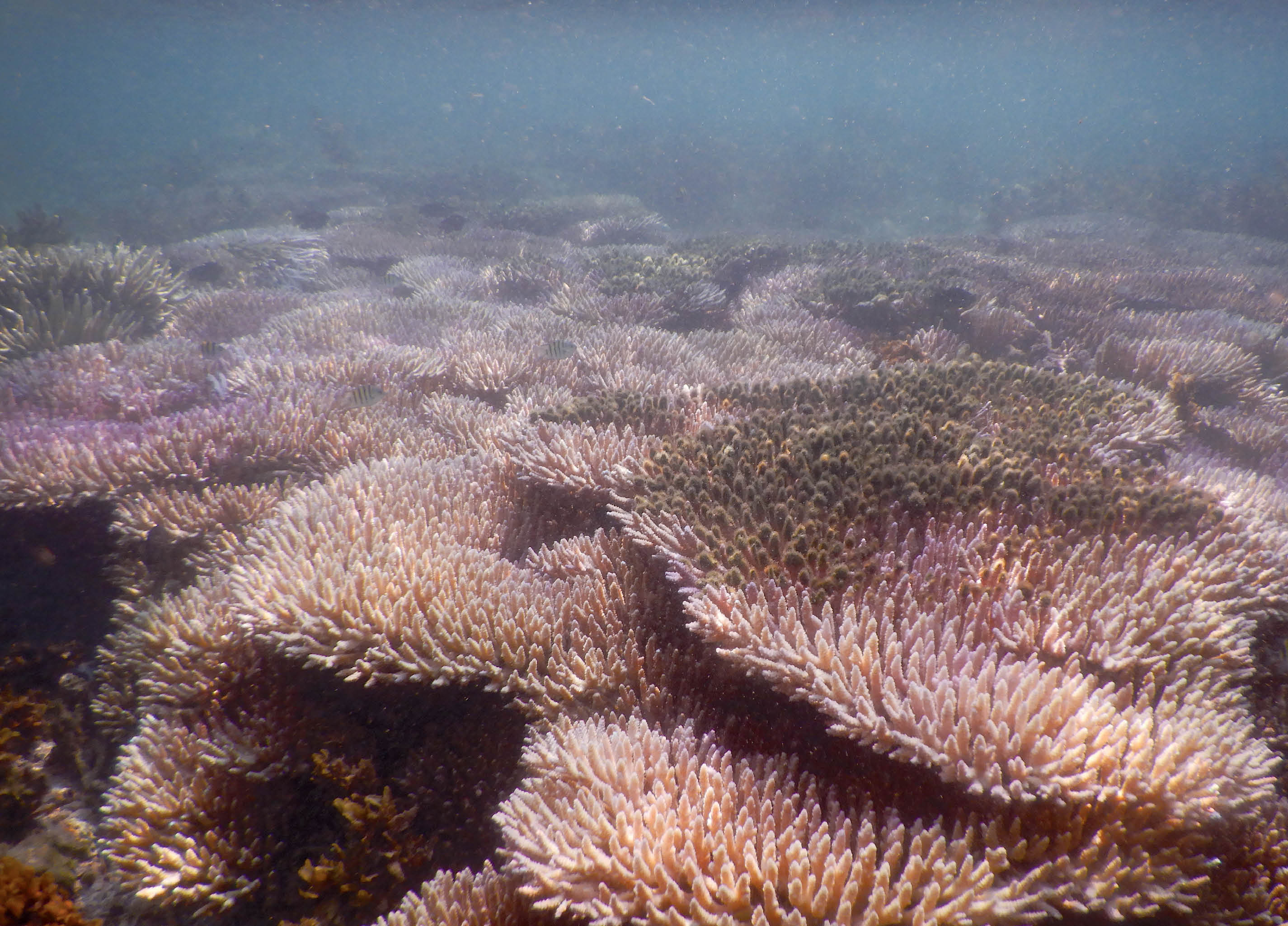
Bleached Acropora hyacinthus in the Gulf of Mannar.
Abstract: Coral reefs are one of the most productive and biodiverse marine ecosystems on earth which are currently facing imminent risk of collapse globally due to natural and anthropogenic stressors. One of the critical factors is the El Niño Southern Oscillation (ENSO) events. For example, elevated sea surface temperature (ESST) anomalies of 1998, 2010, and 2016 and consequent events have resulted in a drastic decline in coral reefs in several parts of India. However, the dynamics and mechanisms driving these changes and their effect on ecosystem functions are poorly understood.
The author is the Managing Director, Srushti Conservation Foundation, Pune. director@the-scf.org. The article should be cited as D. Apte. 2022. Coral Reefs in a Changing Climate. Geography and You, 22 (148): 52-57
Glaw Lake was recently designated as Arunachal Pradesh’s First and India’s 101st Ramsar Site. It is located within the Kamlang Tiger Reserve and Wildlife Sanctuary. It hosts diverse flora and fauna sp...
Maritime chokepoints are vital points along shipping routes that facilitate the passage of substantial trade volumes. These chokepoints control the global essential supplies such as oil, gas, fertiliz...
What if India's pathway to net zero does not end at factories—but begins where terrestrial meets the coastal? As carbon emissions rise and climate risks intensify, the search for solutions has largely...
India is set to embark on a new chapter in its Polar exploration journey with the construction of Maitri II. The Indian government plans to establish a new research station near the existing Maitri ba...