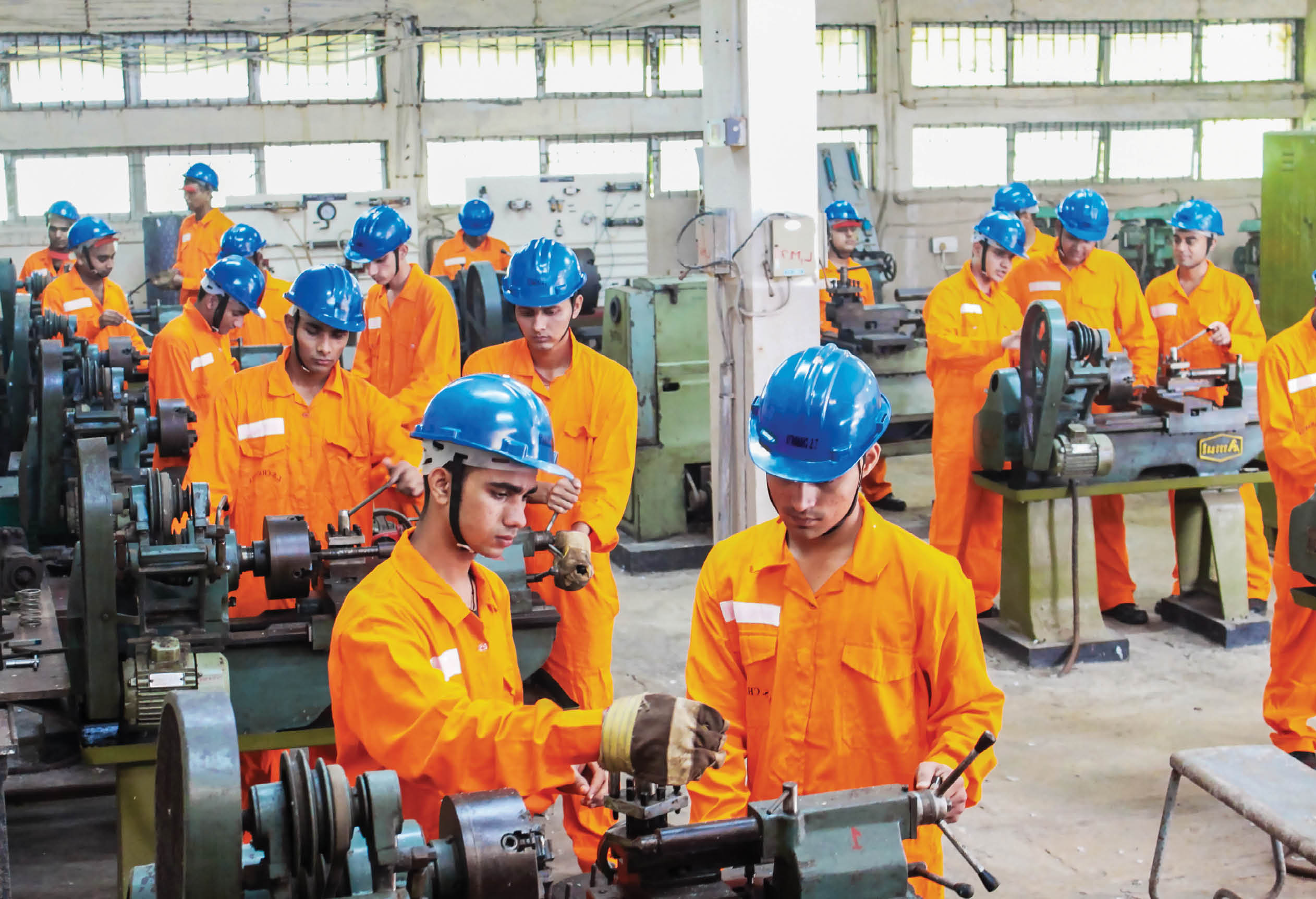
To meet the demands of a growing economy, India will need to develop a skilled workforce in 24 key sectors.
Abstract: By 2025, an unprecedented demographic transition will put India in a position where 64 per cent of its population will be of working age. Currently, the absence of a skilled workforce ails the economy. An overhaul of our education system is required to rectify the current flaws and to cater to the needs of a growing economy.
India is set to embark on a new chapter in its Polar exploration journey with the construction of Maitri II. The Indian government plans to establish a new research station near the existing Maitri ba...
The Deep Ocean Mission (DOM), approved by the Government of India in 2021 under the Ministry of Earth Sciences (MoES), represents a strategic step in realizing Sustainable Development Goal 14 (SDG 14:...
China recently announced restrictions on the export of seven rare earth elements (REEs), soon after US President Donald Trump decided to impose tariffs. As the world's dominant supplier—responsible fo...
The International Seabed Authority (ISA) marked a watershed moment on September 15, 2025, signing a 15-year contract with the Indian government, revolutionising deep-sea exploration. India has been gr...
The Gender Parity Index (GPI) is the ratio of the number of girls to boys enrolled in a given stage of education, such as secondary education. The index is used to measure access to education for females.
Proficient literacy in two languages is known as biliteracy. A person is biliterate if he/she has the ability to read, write and understand the languages competently.
A person with expertise in multiple subjects is known as a polymath. The word emerged from the Greek word polumathēs, which translates to having much knowledge.
The rate of students that leave a course at an intermediate stage is known as the dropout rate. It is calculated as the ratio of number of students no longer enrolled at the end of a year to the number of students enrolled in the beginning of the year.
Tertiary education is the level of education which is received after the secondary or equivalent education level. In major parts of the world, the term higher education is also used.
Vocational education or vocational training is a training programme which focuses on the knowledge and skills required for a definite job or a craft.
Dyslexia is a reading disability due to neurological dysfunction. Students suffering from dyslexia often experience difficulty in understanding individual letters, words or paragraphs.
Distance education is an educational programme which does not require students to be physically present. It includes online learning, home study, open education and correspondence courses.
Artificial Intelligence (AI) is the intelligence shown by machines, distinguishable from intelligence shown by humans, which is known as natural intelligence (NI). The term AI is used when a machine imitates ‘cognitive’ features similar to humans, such as problem-solving and analytical thinking.