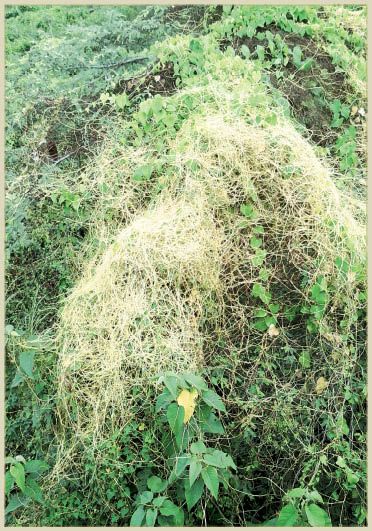
The biocontrol efficiency of Cuscuta reflexa can be tested on the proliferation of Prosopis juliflora or vilayati keekar, which damages the native species in the arid and semi-arid tracts of the Aravalli
Abstract: The unique climatic and edaphic characteristics of India assist biological invasion by alien species like the vilayati keekar that damage native diversity. Control methods for eradicating the species have proved futile. Although the biocontrol efficiency of Cuscuta reflexa has been established, the agent requires further trials for successful deployment.
The author is a Fellow, Centre for Biodiversity Policy and Law (CEBPOL), National Biodiversity Authority, Chennai. ssandilyan@gmail.com
What if India's pathway to net zero does not end at factories—but begins where terrestrial meets the coastal? As carbon emissions rise and climate risks intensify, the search for solutions has largely...
India is set to embark on a new chapter in its Polar exploration journey with the construction of Maitri II. The Indian government plans to establish a new research station near the existing Maitri ba...
The Deep Ocean Mission (DOM), approved by the Government of India in 2021 under the Ministry of Earth Sciences (MoES), represents a strategic step in realizing Sustainable Development Goal 14 (SDG 14:...
China recently announced restrictions on the export of seven rare earth elements (REEs), soon after US President Donald Trump decided to impose tariffs. As the world's dominant supplier—responsible fo...