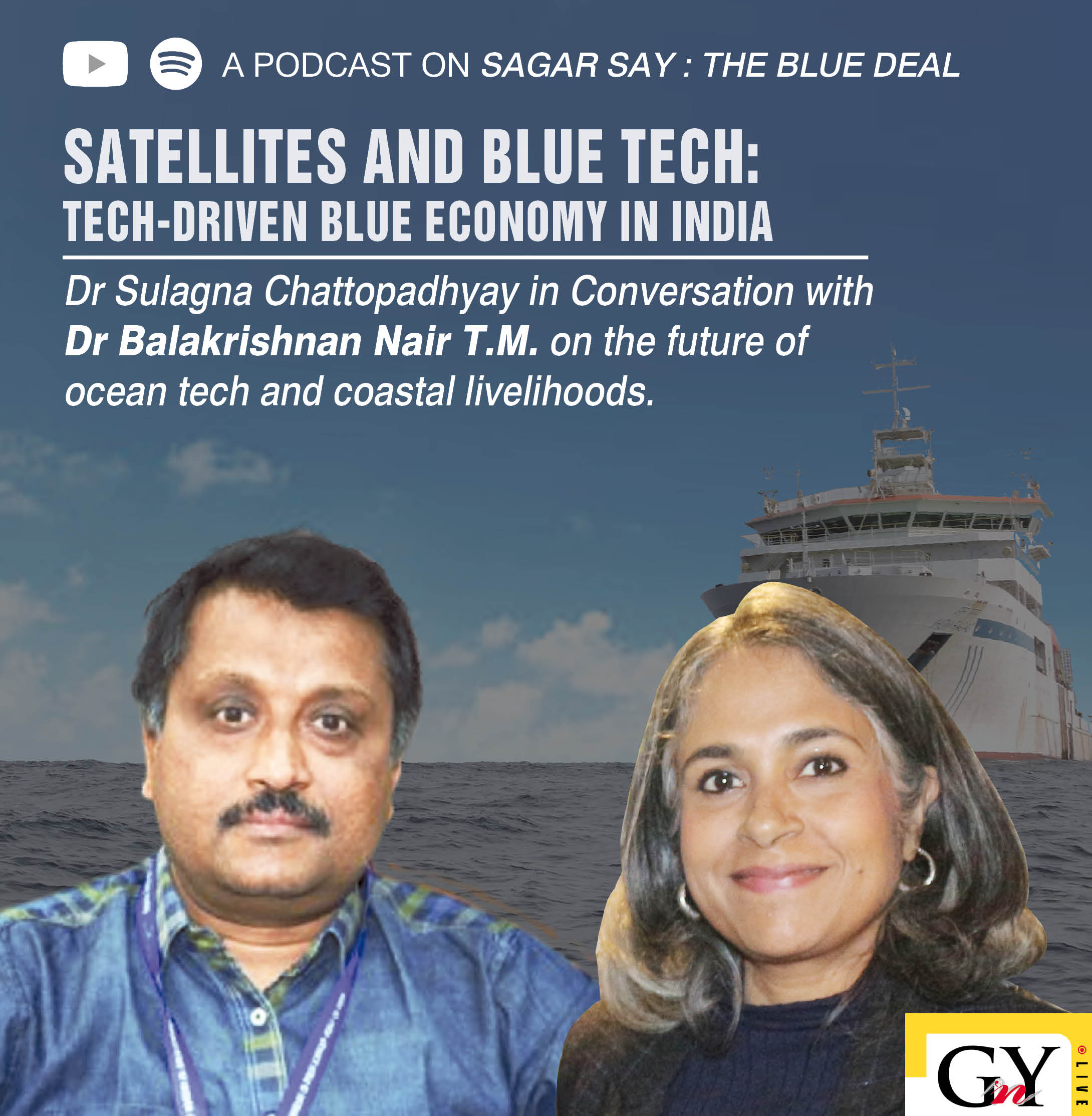
Abstract: The oceans, covering over 70 per cent of the Earth’s surface, have long been perceived as infinite reservoirs of resources. However, with the escalation of climate change impacts and pressures from human activities, a strategic rethinking of ocean governance is imperative. In this edition of GnY Live, Dr. Bala Krishnan Nair, a senior scientist and Director at the Indian National Centre for Ocean Information Services (INCOIS), sheds light on India’s Blue Economy landscape. The dialogue delves into the current status of India’s draft Blue Economy policy, its sectoral focus, the overlooked dimensions of climate risk, and the crucial contributions of science in enabling marine governance. Dr. Nair outlines how living marine resources—encompassing both traditional fisheries and emerging sectors like mariculture—form the backbone of coastal livelihoods. He stresses the importance of integrating climate resilience, disaster preparedness, and real-time ocean information into long-term national planning. The conversation ultimately provides a vision for a sustainable and inclusive ocean economy in India, shaped by both technological foresight and grassroots engagement.
Glaw Lake was recently designated as Arunachal Pradesh’s First and India’s 101st Ramsar Site. It is located within the Kamlang Tiger Reserve and Wildlife Sanctuary. It hosts diverse flora and fauna sp...
Maritime chokepoints are vital points along shipping routes that facilitate the passage of substantial trade volumes. These chokepoints control the global essential supplies such as oil, gas, fertiliz...
What if India's pathway to net zero does not end at factories—but begins where terrestrial meets the coastal? As carbon emissions rise and climate risks intensify, the search for solutions has largely...
India is set to embark on a new chapter in its Polar exploration journey with the construction of Maitri II. The Indian government plans to establish a new research station near the existing Maitri ba...